Building a Disaster Recovery Strategy for Your Mission-Critical SAP Landscape

Contributor:

Madhusudan Y
Associate Director 17.11.2025Reading Time:
7 Minutes
Many enterprises believe their Disaster Recovery (DR) are fail proof, until they are tested . Cloud promises rapid recovery, redundant backups, and theoretically sound architectures. Yet, in an era of AI-powered cyberattacks capable of targeting primary and backup sites simultaneously, this theoretical confidence is a growing liability.
Real-world failure simulations often reveal a different reality: a single orchestration gap or untested integration can render a multi-million-dollar DR plan ineffective, turning a projected four-hour recovery into an eight-hour business disruption
One global manufacturer discovered this firsthand—a simulated outage impacting both primary and backup SAP environments led to over eight hours of downtime and an estimated $2 million in losses.
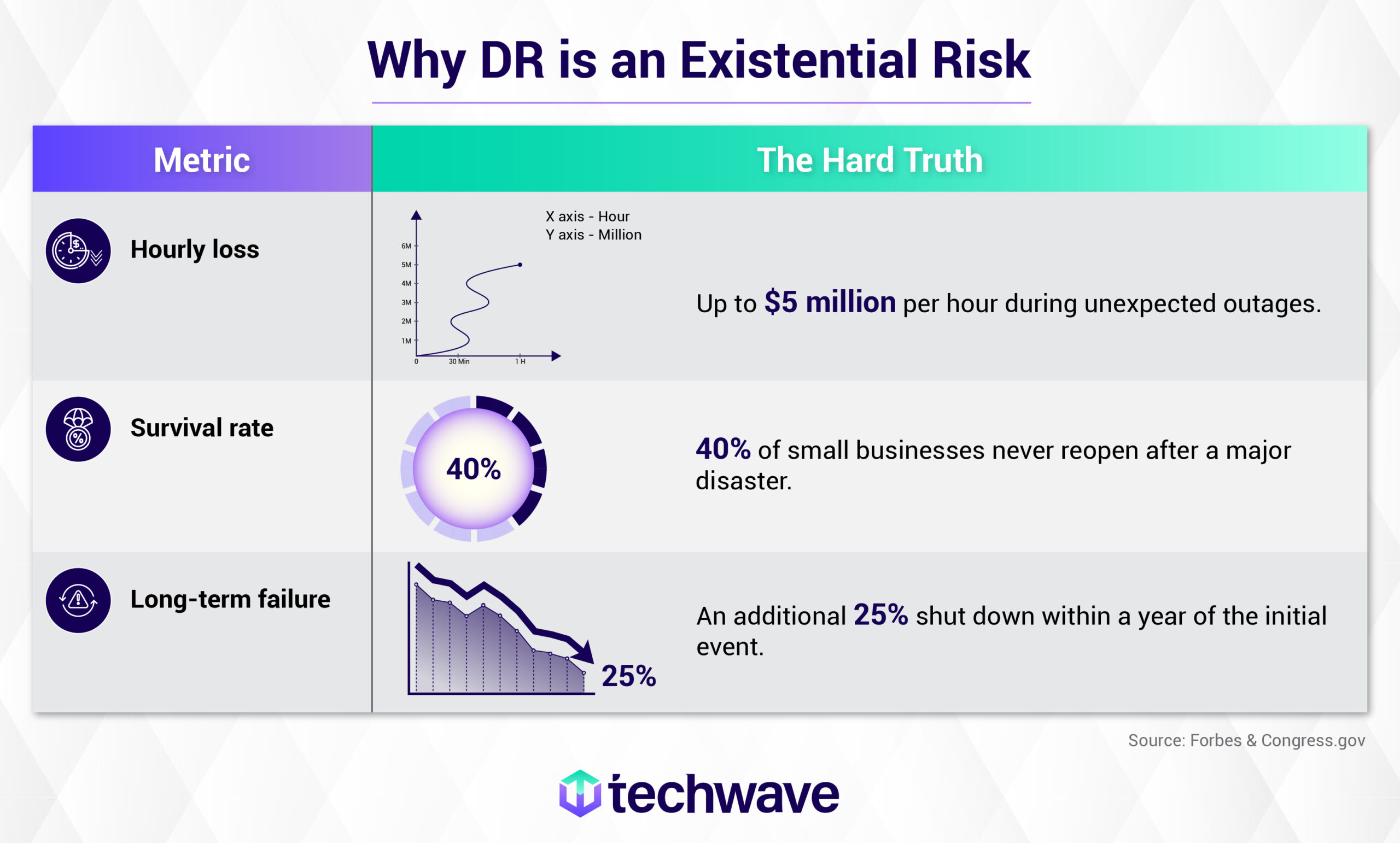
Such an event is not merely a technical failure; it is a direct and quantifiable business risk. For one organization, a simulated disaster that incapacitated primary and backup sites led to a recovery time exceeding eight hours—double the planned objective. The financial impact was calculated at over $2 million in simulated losses, translating to an hourly cost of resilience that no leadership team can ignore.
This gap between planned and actual resilience is a pervasive challenge. Gartner research indicates that 72% of organizations are poorly positioned in terms of their disaster recovery capabilities, with 63% likely suffering from a “mirage of overconfidence”.
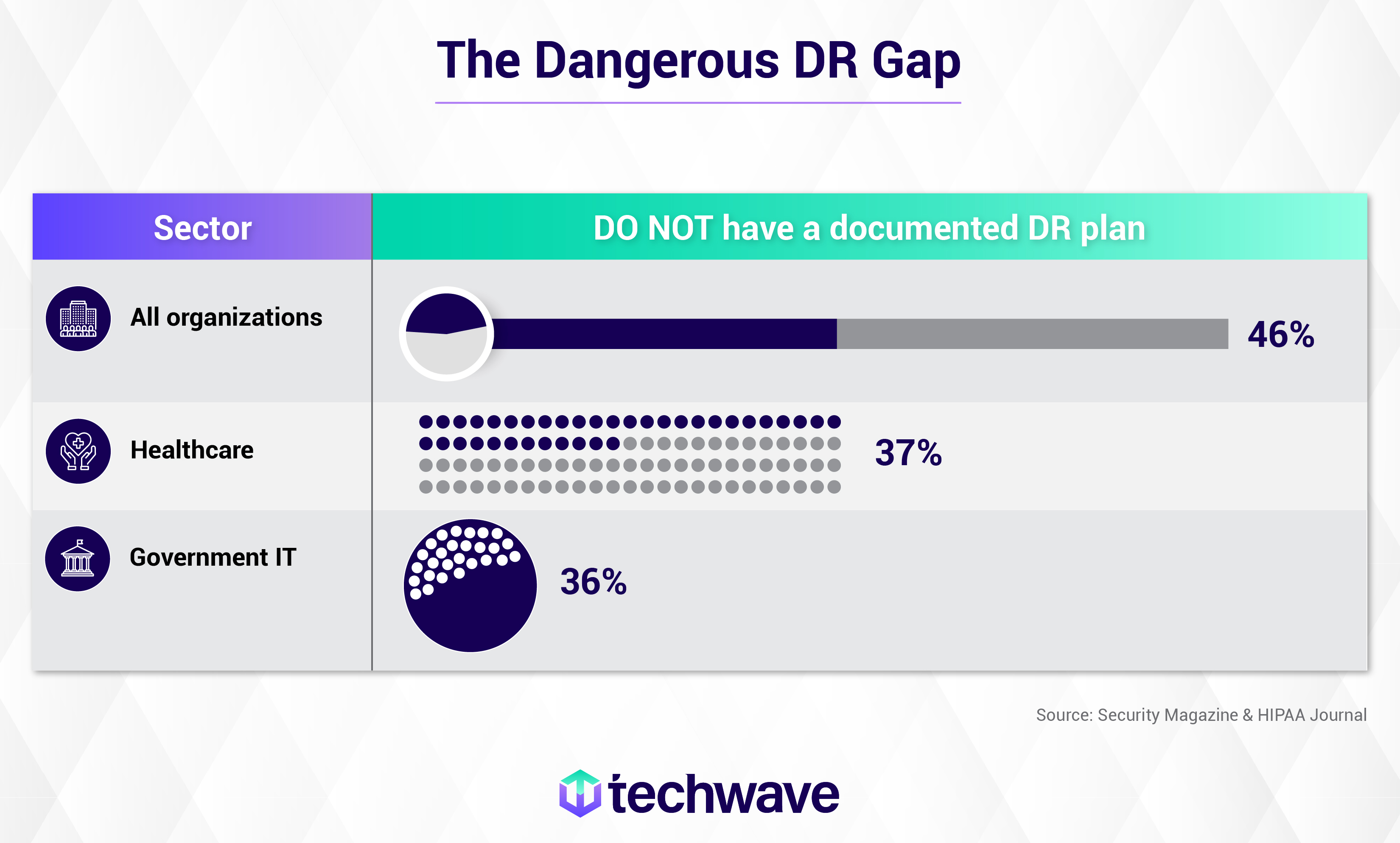
This is particularly critical when the system in question is the SAP landscape, which often forms the operational backbone of the enterprise. For organizations navigating the mandatory transition from SAP ECC 6.0 to S/4HANA by 2027, this is a pivotal moment to architect resilience into the core of their future operations, rather than retrofitting it later. Because when SAP systems fail, core business processes—from supply chain and logistics to finance and customer service—cease to function.
A structured, rigorously tested disaster recovery strategy for SAP is, therefore, no longer an IT contingency; it is a non-negotiable component of business continuity and corporate governance. It provides the only verifiable means to restore operations, meet new regulatory demands for cyber resilience, and maintain stakeholder trust in an era where downtime equates to direct financial, operational, and reputational damage.
What is the foundation of a modern disaster recovery strategy for SAP?
A modern SAP Disaster Recovery (DR) strategy must be understood not as a static insurance policy, but as a dynamic, integral component of business resilience. It is the pre-defined capability to restore mission-critical operations within a timeframe that minimizes financial, operational, and reputational damage. While often driven by compliance requirements, its true value is strategic: it directly underpins enterprise viability during a crisis.
Effective DR transcends a one-size-fits-all checklist. It requires a tailored approach, where the recovery objectives for each SAP module are precisely calibrated to its role in the value chain.
This strategy rests on three interdependent pillars:
- Business-centric objectives – Align recovery priorities to revenue and operational criticality.
- SAP-centric architecture – Address the complexity of interconnected SAP modules, databases, and integrations.
- Hyperscaler-driven execution – Leverage cloud-native replication, orchestration, and scalability through platforms such as AWS or Azure.
Failure in any pillar undermines the entire structure. True resilience emerges only when business leadership, SAP architects, and cloud engineers collaborate to create a unified, continuously validated recovery model.
“Unlike generic IT workloads, SAP’s interdependencies demand orchestration across every layer—business, application, and infrastructure. That’s what separates theoretical recovery from operational resilience.”
1. Quantify risk and define business imperatives through a rigorous Business Impact Analysis (BIA).
A modern DR strategy is an economic decision, not a technical backup exercise. Before architecting solutions, leaders must define the financial and operational stakes by answering: What is the cost of downtime, and what data loss is tolerable?
A formal Business Impact Analysis (BIA) and Risk Assessment (RA) provide this clarity, moving the conversation from IT recovery to business survival. The BIA quantifies the financial impact of disruption for each SAP module, while the RA identifies probable threat scenarios.
The outcome is a clear set of tiered recovery objectives, which directly dictate architectural complexity and cost. Critically, this establishes two non-negotiable metrics for each application:
Recovery Time Objective (RTO): The maximum tolerable downtime, defining the urgency of restoration. (e.g., 2 hours of downtime)
Recovery Point Objective (RPO): The maximum tolerable data loss, defining the required frequency of data protection. (e.g., 10 minutes of data loss)
These metrics are not IT goals but business mandates, forming the foundational contract between leadership and the technology function and determining the viability of the entire DR budget.
2. Optimize investment through a tiered resilience model aligned to business criticality.
A uniform disaster recovery approach represents a significant misallocation of capital, simultaneously over-protecting non-essential systems and creating dangerous exposure for mission-critical operations.
The most effective strategy treats resilience as a strategic portfolio, allocating technology spend precisely to the business risk and financial impact of each SAP workload.
A three-tiered model ensures capital efficiency while guaranteeing that core revenue-generating systems are never compromised.
Tier 1: Mission-critical (e.g., Core S/4HANA Production): For systems where downtime directly halts operations and near-zero data loss is non-negotiable, the investment mandates real-time replication and pre-provisioned infrastructure for immediate failover. This tier carries the highest cost but protects against existential revenue and reputational loss.
Tier 2: Business-critical (e.g., Development, QA): For systems essential for medium-term continuity but capable of tolerating short outages, the strategy shifts to high-frequency backups and snapshots. Infrastructure can be provisioned at the time of disaster, achieving a balance of protection and significant cost optimization.
Tier 3: Non-critical (e.g., Sandbox, Training): For systems with no direct impact on live operations, the goal is data retention at the lowest possible cost. This is achieved through periodic backups to low-cost object storage, accepting recovery times of 24 hours or more.
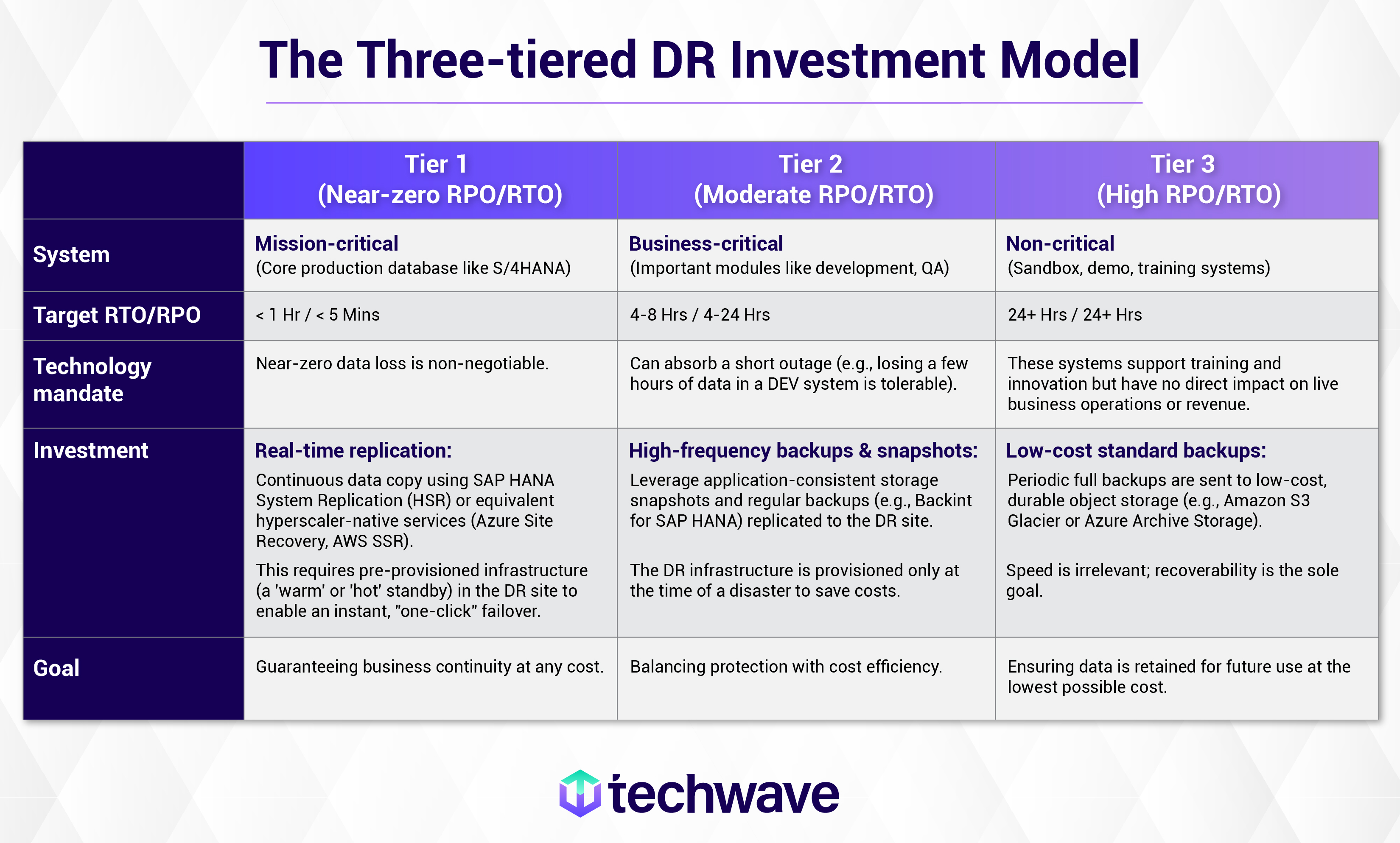
The discipline lies in rigorously classifying each SAP component and resisting the urge to deviate from the prescribed technological and financial solution for its tier. This model transforms DR from a blanket insurance premium into a precise, risk-adjusted capital allocation.
3. Leverage the economic and operational advantages of cloud-native disaster recovery.
The global cloud DR market is projected to reach $92.8 billion by 2033. Implying, the paradigm for disaster recovery has fundamentally shifted from maintaining costly, idle infrastructure to leveraging the on-demand scalability of the cloud.
This transition is not merely technological but economic; it enables a pay-for-capacity model that eliminates the capital expense of a secondary data center and converts it to a variable operational cost.
For SAP landscapes, this means achieving enterprise-grade resilience without the prohibitive overhead, aligning protection costs directly with actual usage and risk.
Cloud platforms provide the essential toolkit for this modern approach. The integration of SAP HANA System Replication (HSR) with hyperscaler-native orchestration services (such as Azure Site Recovery or AWS Elastic Disaster Recovery) enables automated, reliable failover of the entire SAP stack.
This technical foundation is what makes a tiered investment model operationally possible, allowing mission-critical tiers to be configured for immediate recovery while less critical systems utilize more cost-efficient, on-demand restoration.
A critical consideration in this model is software licensing. SAP HANA licenses are often tied to specific instance types or hardware, making DR-specific licensing agreements essential to prevent compliance violations and unplanned financial exposure during a failover event. Proactively addressing this ensures the economic model of cloud DR is not undermined by unforeseen costs.
4. Mandate full automation to transform recovery from a manual panic into a reliable process.
By 2026, 30% of enterprises will automate over half their network activities, making automation the standard for resilience.
In complex SAP landscapes, manual failover processes pose a significant risk by introducing human error, inconsistency, and delays, which directly violate stringent RTOs and amplify business losses.
Achieving sub-hour recovery and ensuring stable operations afterward is impossible without end-to-end automation. This extends beyond the initial failover to the often-overlooked process of failback, where manual procedures can cause data inconsistency and extended disruption, negating the initial recovery investment.
Infrastructure-as-Code (IaC) for failover orchestration: Codifying the entire SAP environment—from servers and networks to application configurations—using tools like Terraform or Ansible enables rapid, repeatable, and error-free reconstruction in the disaster recovery site. This eliminates manual configuration drift and is the foundation for a predictable, one-click failover capability.
Automated failback for operational stability: A robust DR strategy is incomplete without a scripted and tested failback procedure. Automation ensures that returning to the primary site is as controlled and reliable as the initial failover, protecting data integrity and preventing a secondary business disruption.
SAP-centric orchestration tools: Solutions like SAP Landscape Management (LaMa) and hyperscaler-native services provide the application-level intelligence to coordinate the shutdown, startup, and health checks of the interdependent SAP stack, ensuring the entire system recovers cohesively.
The collective impact of these automated capabilities is to de-risk the recovery process entirely. By codifying recovery, enterprises transform their DR strategy from a theoretical document into an executable asset, ensuring that the capital allocated to resilience delivers a guaranteed and measurable return.
The golden rule is to test, test, and test again. An untested DR plan is just a document. For mission-critical SAP, a regimen of regular, full-scale drills is essential to expose orchestration gaps, verify technical procedures, and ensure the plan functions as a reliable business safeguard rather than a stagnant document. This discipline closes the critical loop between strategy investment and operational certainty.
The foundational steps outlined so far provide a robust technical blueprint. For senior leaders, however, the ultimate value of a disaster recovery strategy is realized only when it is treated as a dynamic business program, governed by three strategic imperatives that determine its long-term efficacy and return on investment.
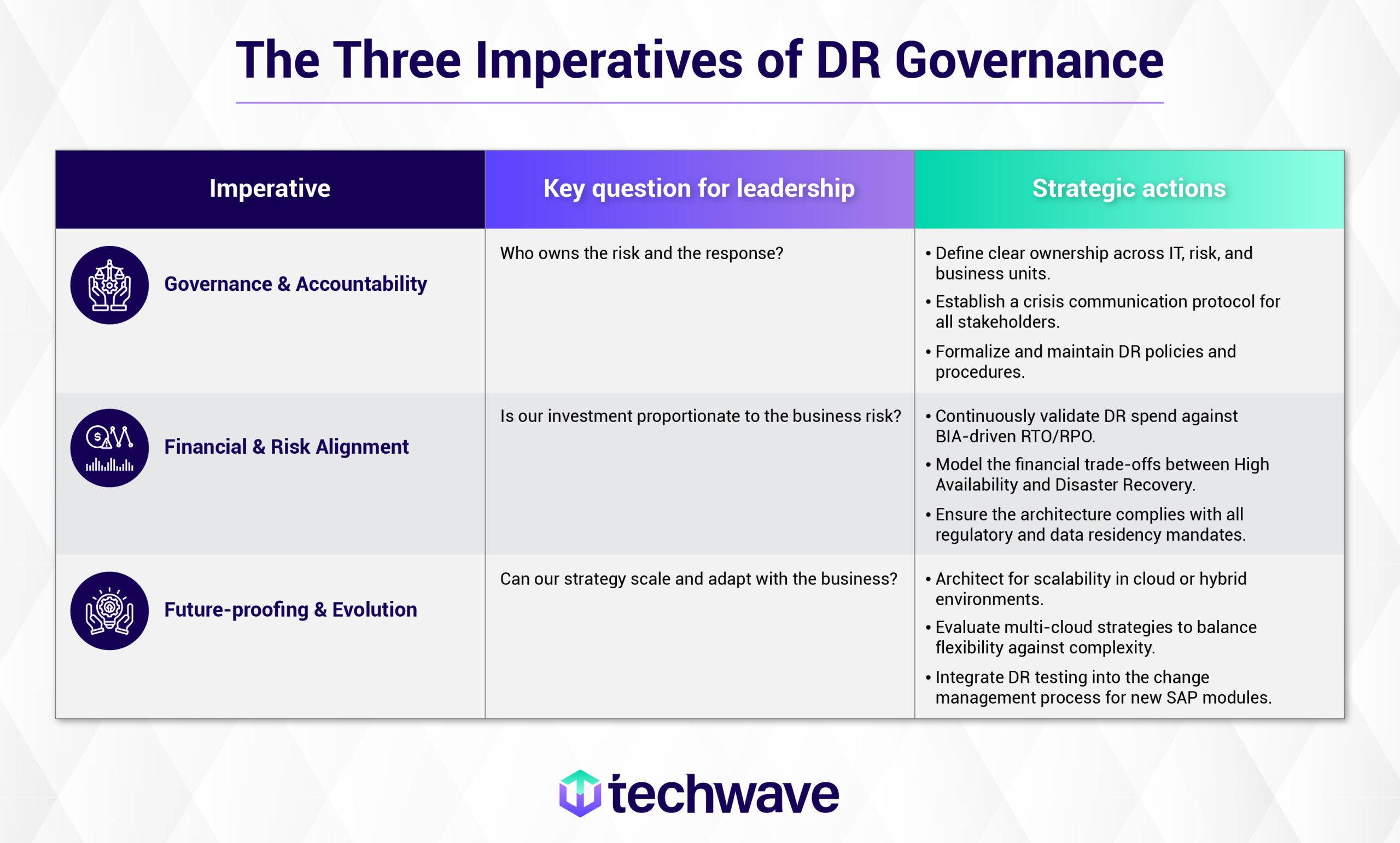
This governance model ensures that disaster recovery remains a living, breathing component of corporate strategy—a verifiable asset that protects not only current operations but also the organization’s future strategic flexibility.
For leaders, the imperative is to select a partner that brings proven, automated DR patterns for SAP on AWS and Azure. The goal is a partnership that delivers not just a plan, but a resilient capability built on infrastructure-as-code and hyperscaler-native services.